Thursday, January 3, 2008

GCT 620mm

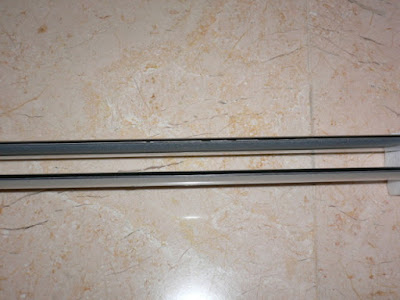
Prior to flying the rotor tech 610mm, I was flying the GCT 620mm blades. Gotta admit I was kinda caught up in the "longer is better" hype. These blades came in a nice hard box and were hold apart by two foam spacer. A much better way of blade packaging compared to the funkey method of plastic sheet between blades that I am used to. Supposed to be carbon blades, not sure if its pure CF or just CF reinforced. Narrow cord at 50mm and weights 140g.

They look nice. Black, silver and white top with a silver finish on the bottom. Looks great with the TT green paddles. Came balanced. The leading edge had some imperfection but it flies fine.
Initial Flight Feel
Exceptional climb rate. It had very good punch compared to the Funkey FG blades that I had always been using. Cyclic wasn't fast, but it wasn't too slow either. My heli suddenly climb so well and fast that my loops became so much more larger than it was.
After a Good Amount of Time with These Blades
Initially I thought the bogging on flips and rolls was because of engine tuning because I was still running extremely rich when I first tested these blades. However, my engine never really seemed to regain the power that it had. Later I realised that it was because of this blades. The blades were fine in a climbout even holding 11degree of pitch. It will loop and roll fine. Large open maneuvers like funnel, rolling stall turn, hurricane was all great with this blades. It was only when you do fast and tight maneuvers like tic-tocs that this blades simply cannot catch up with. Overall, I would think it will perform great as a pair of F3C learning blades than 3D flying. One thing I discovered was that despite the constant loading and slight bogging of my engine, my engine actually ran cooler with these blades. Weird, but true. They are great for learning aerobatics, but definately not 3D. Autos are easy with this, not a hell lot of hang time, but it auto way much better than the rotor tech 610mm or Funkey 600mm.
Sold them to one of my flying buddies after a few months of flying with these blades.

OS Hyper

This engine loves to eat bearings for breakfast and piston for lunch. However, unlike my previous Thundertiger engines, I found that having a plug life of 5 or 6 gallons is pretty common. I never really felt that it was a lot more powerful like everyone else is claiming until I upped the headspeed and got the hatori 522 muffler. The 60L carb is really large for an engine this size and it sure drinks for its size. The 330cc tank on my raptor only last for 8mins flat from full to header. Its an amazingly good engine not because its extremely smooth or powerful, but because it just continue to run and idle well no matter how badly it is tuned. It could idle well even when I was just running in pretty rich.

I was getting around 5-6 gallons per rear bearing. I went through 3 piston and rings. First 2 lasted 11gallons each while the third one broke after 5.5gallons.

I recently replaced the ring, piston, cylinder liner and con-rod after the 3rd ring broke. 28gallons wore out my con-rod slightly, not a lot, but it was cheap, so I replaced it for a peace of mind. My cylinder liner got scratched slightly, so I got it replaced too. Why not replace the whole engine when the price to repair is more than half of a new engine? Because I am still waiting to for more flight reports on the new TT redline engine and so there is no point in buying a brand new hyper and just use it for a few gallons.
New vs Old. Note the finish on the new liner. Its suppose to look like that, a bit rough and honed to help the new ring to bed in.
28 gallons haven't worn the con-rod a lot, but replaced it because there was a bit of free-play.MY new hobby-Collecting pistons :( :(

Praying hard that the new piston and ring will last me till I get the redline.

Tuesday, January 1, 2008

Logictech 6100t

This is suppose to be a great gyro and without a doubt, it is. Was told its comparable to the GY611 and since the Gy611 was a lot more expensive at my LHS than pretty much anywhere else in the world, so I ordered this instead.


Its really tiny and light compared to the GY502 I had, yet it still has a LCD screen and buttons for adjusting the parameters. Its just slightly larger than the GY502 sensor and so mounts onto my raptor 50 gyro mounting area with no issus. This is pretty important to me because the raptor hasn't got much electronics mounting area at the front and back then I was running 2x sanyo 1500mah nicd pack and was slightly nose heavy. Servo comes with a metal heatsink casing, which I guess is already standard nowadays. Lighting fast servo at 0.05s. A word of caution though, the included gyro mounting tape sucks. It seems ever so ready to be split apart by a light pull. I am using the 3m white foam tape now. The included servo horn was a round one with un-cut 4arms star shape marking, i.e. it came as a round servo wheel. Maybe its a feature, but who use a round servo wheel on rudder anyway. It was a bit of hassle to cut it myself.

I found the piro to be much more consistent than the gy502 and at slow piro rates, it is actually extremely smooth and slow. With a lower end gyro, I found that slow piros usually ends up choppy and step-like. Piro is extremely fast, sensitive and it holds good. Piro rate is smooth and predictable even in rippers. Holds good even when doing a rolling stall turn. However, the piro I get from this in a K.E flight is pretty inconsistent. Holding ability can be improved though, it does not blow out, just drift slightly occasionally. So far I have only blown the tail once with this gyro and it was because I lost quite a bit of rpm, so it wasn't the gyro's fault.


I have logged 140flights with this thus far and it still is working great with no sign of wear on the servo.

I tried to use this gyro with some other servos and apparently, you cannot use any other servos with this gyro. It worked with the other servos, but the servo was constantly jittering which I think would wear out the servo.


Comes in a nice package.